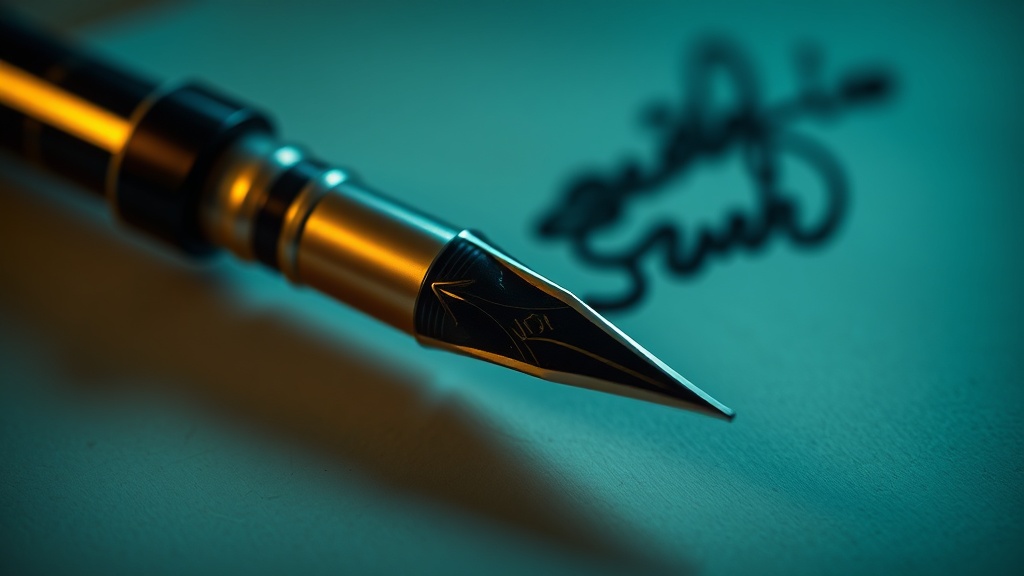
Ink and History: How Evolution of Writing Tools Changed Signatures

This post examines how the evolution of writing instruments—from quill pens to modern ballpoint pens—has fundamentally altered the physical characteristics, stroke consistency, and long-term preservation of historical signatures. You'll see how the transition from liquid ink to pressurized ink changed the way collectors identify authenticity and how different tools affect the longevity of an autograph on paper.
How Did the Evolution of Writing Tools Change Signatures?
The evolution of writing tools changed signatures by shifting them from fluid, variable-pressure strokes to more standardized, consistent, and sometimes shallower impressions. Early writing tools like quills required constant dipping and precise pressure, resulting in signatures with deep ink pools and varying line thickness. Modern tools like the ballpoint pen produce a much more uniform, thinner line that lacks the organic "bleed" seen in older documents.
When you're looking at a 19th-century document, you aren't just looking at ink on paper; you're looking at the physics of the tool used. A quill pen or a fountain pen creates a "wet" signature. This means the ink sits on top of the fibers or penetrates them deeply depending on the nib's width. If you see a signature that looks too uniform or lacks any variation in line weight, it might be a sign of a modern tool being used to mimic an older style.
The shift from liquid ink to solid-state delivery changed the "soul" of the signature. A fountain pen allows for "shading"—where the ink appears darker in some parts of a stroke than others. This is a hallmark of high-quality, hand-signed documents. On the flip side, a standard Bic ballpoint pen delivers a very consistent, thin line that doesn't offer much room for artistic flair or character. For collectors, this distinction is a major clue when dating a piece.
The Era of the Quill and Dip Pen
Before the mid-19th century, the quill was king. These tools were temperamental. A writer had to dip the pen frequently, meaning the signature's beginning and end often had different ink densities. This creates a natural "tapering" effect. If you're examining a historical document, look for those subtle changes in ink saturation. It's a sign of a genuine, manual process.
The dip pen followed, offering a bit more control but still relying on a separate inkwell. This meant the ink was often more viscous and "watery" than modern versions. This can lead to feathering—where the ink spreads into the paper fibers. If you're worried about how these older inks might react over time, you should understand why high-end paper and ink longevity matters for collectors.
How Does Ink Type Affect Autograph Longevity?
Ink type affects longevity by determining how much the pigment reacts to light, oxygen, and the paper substrate. Different chemistries—such as iron gall, dye-based, or pigment-based inks—behave differently as they age. Some inks are incredibly stable, while others can fade or even become acidic and eat through the paper over decades.
Let's look at the three main categories of ink found in the collecting world:
- Iron Gall Ink: Common in historical documents. It is highly acidic and can actually "burn" through paper over centuries if not stored correctly.
- Fountain Pen Ink (Dye-based): These are beautiful and vibrant but are notoriously sensitive to UV light. They can fade significantly if left in the sun.
- Ballpoint Ink (Oil-based): These are very stable and rarely fade, but they can sometimes sit on top of the paper rather than soaking in, making them prone to smearing if touched.
The chemistry of the ink is just as important as the tool itself. For example, ink chemistry is a complex field, but for a collector, the takeaway is simple: a "wet" ink signature from a fountain pen is much more vulnerable to environmental damage than a dry-looking ballpoint signature. This is why environmental control is a non-negotiable part of the hobby.
If you have a collection with diverse ink types, you can't treat them all the same. A signature written in a high-quality pigment ink will behave differently than one written in a cheap, dye-based felt tip. It's a constant balancing act. (I've seen many collectors lose a beautiful signed photo simply because they didn't realize how light-sensitive the ink was.)
Comparing Writing Tools and Their Impact
| Tool Type | Stroke Consistency | Ink Saturation | Collector's Note |
|---|---|---|---|
| Quill/Dip Pen | High Variation | High (Wet) | Look for "feathering" and ink pools. |
| Fountain Pen | Moderate Variation | Moderate (Fluid) | Excellent for artistic, "shaded" signatures. |
| Ballpoint Pen | Very Low (Uniform) | Low (Dry) | Often looks "flat" compared to liquid inks. |
| Sharpie/Felt Tip | Consistent/Bold | High (Opaque) | Can bleed heavily into paper fibers. |
Why Does Paper Quality Matter for Signatures?
Paper quality matters because the surface texture and absorbency dictate how the ink interacts with the fibers. A smooth, coated paper will keep the ink on the surface, while a textured, porous paper will pull the ink in, often causing the signature to look softer or more blurred.
When a person signs a document, they aren't just applying ink; they are applying pressure. This pressure creates a physical indentation in the paper. This is a vital part of the "feel" of an authentic signature. A ballpoint pen might leave a shallow groove, but a fountain pen can leave a significant, tactile impression. If you're examining a signature under a light, look for that physical depth. It's much harder to fake than the color itself.
The way the paper reacts to the ink is also a major factor in long-term value. If the paper is too acidic, the ink might react poorly. This is a common issue with older, lower-quality paper stocks used in the early 20th century. You'll often see "acid burn" where the signature seems to be sinking into the page. This is why understanding the relationship between paper and ink is so important for anyone looking to preserve a collection.
The texture of the paper also changes the "drag" of the pen. A person signing with a quill on parchment will have a completely different movement than someone signing with a modern felt-tip marker on a glossy photo. The friction of the surface dictates the speed and fluidity of the stroke. This is why many modern signatures can feel "stiff" compared to historical ones—the tools and the surfaces have become much more standardized and predictable.
One thing to watch out for is "ink bleed." If a person signs with a heavy marker on thin, cheap paper, the ink can spread beyond the intended lines. This isn't just an aesthetic issue; it can actually damage the structural integrity of the paper over time. It’s a way to tell if a signature was done with a tool that was perhaps too heavy for the medium.
That said, even the best signature can be ruined by poor storage. If the paper isn't stable, the ink won't be either. It's a chain reaction of degradation. You've got to look at the whole picture—the tool, the ink, and the surface—to truly understand what you're holding in your hands.